Work tools
Sitrep
Reports that help an organization see what needs attention and who is waiting on whom.
Sitrep brings team updates together so people can see where work stands and what needs a decision. It is built for the distance between the person doing the work and the person who can remove the obstacle.
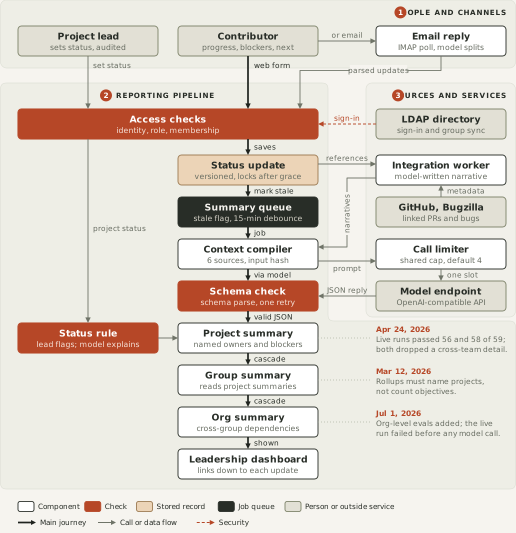
Contributors report progress, blockers, and next steps through the web or by email. Model-generated summaries gather those updates at project, group, and organization levels. The original reports remain available, with context from GitHub and Bugzilla.
A team waiting on another team’s release should still be visible in the organization’s report. Readers need the names, the dependency, and enough detail to act. People set project status; the model explains it and drafts text they can edit.
Recurring reporting periods and reminders keep the updates moving. Plans can be compared with what happened. Memberships, role checks, LDAP sign-in, and audit records let the system serve teams across a larger organization.
How it works / Explore the workflow
From a team update to an organization report
An update starts a new project summary. Group summaries draw on the projects, and the organization report draws on the groups. At each step, the important details have to make the journey. Readers can return to the original updates for a closer look.
Learnings
A summary decides what the next reader gets to know. In an organization, that decision may be repeated several times before anyone acts. A dependency dropped from a project report cannot be recovered by a group summary that never sees the original. The prose can become smoother as the account becomes less useful.
I care most about the details that let someone intervene: who is waiting, what they need, and who can help. These are easy to lose when each project is summarized on its own. Two reports can both say “on track” while the work between them is stuck.
Evaluating this takes more than checking names or headings. A report can mention both teams and omit the fact that one depends on the other. Sitrep’s evaluations exposed that gap even when most checks passed. I want to follow a concrete coordination problem through the whole reporting chain and ask whether the final reader has enough information to act. The original updates also need to remain close enough to consult.